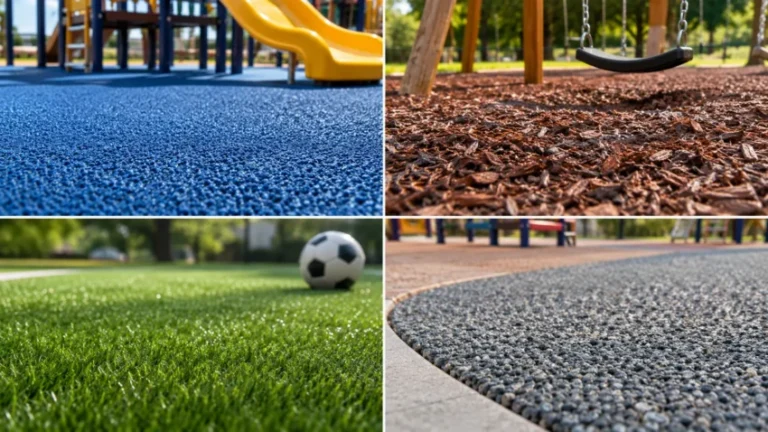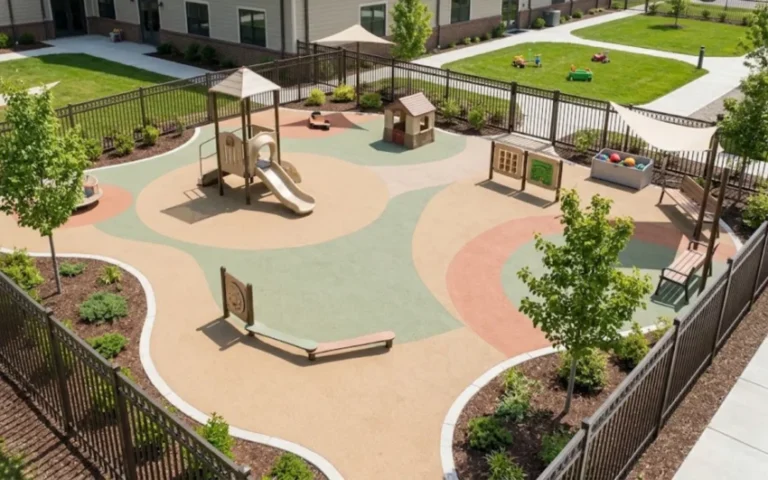
There is no single best playground surface. Poured-in-place rubber, bonded rubber mulch, artificial turf, and Flexi-Pave each fit some projects better than others, and the right choice depends on the equipment and fall heights, accessibility goals, drainage, maintenance capacity, design intent, lifecycle expectations, and the budget inputs of the specific site. Compare systems against your project’s requirements, and confirm each one’s documentation with the manufacturer.
Schools, parks, daycares, architects, and property owners usually start surface selection with a short list and a lot of questions. This guide gives a framework for comparing four systems Custom Park Surfacing installs. It is built to help you decide what to ask, not to name a winner. For deeper two-way comparisons, see our poured-in-place rubber vs. rubber mulch and poured-in-place rubber vs. artificial turf articles.
Key Takeaways
- Start with project requirements, then match a system to them. Starting with a favorite product tends to hide trade-offs.
- Fall protection, accessibility, drainage, maintenance, design flexibility, and lifecycle each deserve their own line in the comparison.
- Documentation matters more than category. Standards apply to specific systems as installed, not to a material type in general.
- Budget is a set of inputs, such as area, base work, site access, and surface choice, not a single number. Ask for a project-specific quote.
- A professional site review can save time before you commit.
What Should You Decide Before Comparing Surfaces?
Surface choice is easier once a few basics are written down.
- Equipment and use zones. What equipment is planned, and what fall heights does the manufacturer specify?
- Users. Ages, abilities, and expected volume.
- Accessibility goals. Which routes and play components need to be reachable.
- Site conditions. Drainage, slope, trees, existing base, and access for equipment.
- Who maintains it. Staff, contractors, or volunteers, and how much time they have.
- Appearance and brand. Colors, patterns, and surrounding landscape.
- Timeline and budget inputs. Not a final figure, but the limits you know.
What Standards Frame the Comparison?
Three references come up on most projects. The U.S. Access Board’s Chapter 10 guide to play areas explains that surfaces on accessible routes must comply with ASTM F1951 and that surfaces within the use zone must be impact attenuating under ASTM F1292. The same guide cautions that one product meeting a standard does not necessarily mean that similar products will. The U.S. Consumer Product Safety Commission publishes the Public Playground Safety Handbook as a guidance reference.
In practice this means you should not accept a general statement that a category of surface is “compliant.” Ask for documentation on the specific system, base, and thickness being proposed, and refer to the current standard. Our ADA compliant playground surfacing page covers accessibility further.
How Do the Four Systems Compare?
The table below is a decision matrix for the questions to ask, not a ranking. Use it to organize a conversation with your designer and installer.
| Factor | Poured-in-place rubber | Bonded rubber mulch | Artificial turf | Flexi-Pave |
|---|---|---|---|---|
| Fall protection | Ask for documentation for the exact system and thickness | Ask for documentation for the exact system and thickness | Ask for documentation for the exact system, base, and any shock-absorbing layer | Ask for documentation for the exact system and thickness |
| Accessibility | Ask for F1951 documentation for the system | Ask for F1951 documentation for the system | Ask for F1951 documentation for the system | Ask for F1951 documentation; Custom Park Surfacing describes it as ADA compliant |
| Drainage | Depends on the system and base; confirm | Depends on the system and base; confirm | Depends on the product and base; confirm | Described as porous; the base and site still decide results |
| Maintenance | Seams, edges, and wear checks; follow manufacturer care | Watch bond and wear; follow manufacturer care | Seams, infill, and drainage checks | Keep pores free of sediment and debris |
| Design flexibility | Colors and shapes, depending on the installer’s options | Color options depend on the product | Look and color vary by product | Standard colors include black, bark brown, redwood, and green |
| Lifecycle | Ask for warranty terms and expected maintenance | Ask for warranty terms and expected maintenance | Ask for warranty terms and expected maintenance | Ask for warranty terms and expected maintenance |
| Budget inputs | Area, base, thickness, color, access | Area, base, depth, access | Area, base, product, access | Area, base, thickness, access |
Notice that several cells say to ask for documentation. That is intentional. Details such as impact attenuation and accessibility performance depend on the product and its installation, and the manufacturer is the source for them.
How Do You Think About Each System?
Poured-in-place rubber. A rubber surface installed on site and bonded together, often considered where a continuous surface and color design matter. Our poured-in-place rubber page describes the product. Review seam and edge details and the base requirements.
Bonded rubber mulch. Rubber mulch bound together to form a surface. Our bonded rubber mulch article explains what it is. Discuss how it holds up under heavy use and what care it needs.
Artificial turf. A synthetic grass surface, which many owners choose for appearance. Our artificial grass for playgrounds page provides detail. Ask how fall protection is addressed in the system under the turf and how drainage is handled.
Flexi-Pave. A porous paving material made largely from recycled tires, poured in place. See the Flexi-Pave product page. Water can pass through the surface, but site drainage still depends on the base and soil. For that reason, see our permeable surface article.
How Should You Weigh Drainage?
Drainage affects how long a surface stays wet, how it is maintained, and how a site handles storms. A surface that is described as porous can still sit over a base that holds water, and a non-porous surface can work well with proper site drainage. Ask the installer to describe the drainage approach for the whole system, including the base and the edges, instead of only the top layer.
How Should You Think About Maintenance and Lifecycle?
Maintenance is easy to underestimate. Compare systems by asking:
- What routine checks are needed, and by whom?
- What repairs are typical, and can staff do them or does an installer need to?
- What cleaning method does the manufacturer recommend?
- What does the warranty cover, and what does it expect of the owner?
- What documentation should you keep?
Lifecycle thinking goes beyond the first installation. It includes inspection, repair, and eventual replacement, so the system you can maintain realistically may be a better fit than one that looks best on day one.
How Should You Build the Budget Inputs?
Cost depends on many variables, so we do not give figures here. The inputs that commonly shape a quote include:
- Surface area
- Existing surface removal and disposal
- Base preparation and drainage work
- Surface thickness for the required fall height
- Color and design
- Site access and working conditions
- Timing and scheduling
Ask for a project-specific quote and compare quotes on the same scope. Our school playground surfacing budget guide walks through budget planning in more detail.
What Is a Sensible Decision Process?
- Write down your requirements from the list above.
- Narrow to two or three systems that plausibly fit.
- Ask each manufacturer or installer for documentation on the exact system.
- Ask for a site visit and a written scope.
- Compare maintenance expectations and warranty terms.
- Decide with the people who will own and maintain the surface.
Frequently Asked Questions
Which playground surface is best? It depends on the project. Compare systems against your own requirements.
Is one type automatically accessible? No. Accessibility depends on the specific system as installed. Ask for documentation.
Can I mix surfaces on one playground? Often, but transitions between surfaces need careful detailing. Discuss it with your designer and installer.
Get a Fit-by-Project Recommendation
If you are comparing surfaces for a school, park, daycare, or property, contact Custom Park Surfacing or call (410) 760-8200 to talk through your site and the documentation to request.