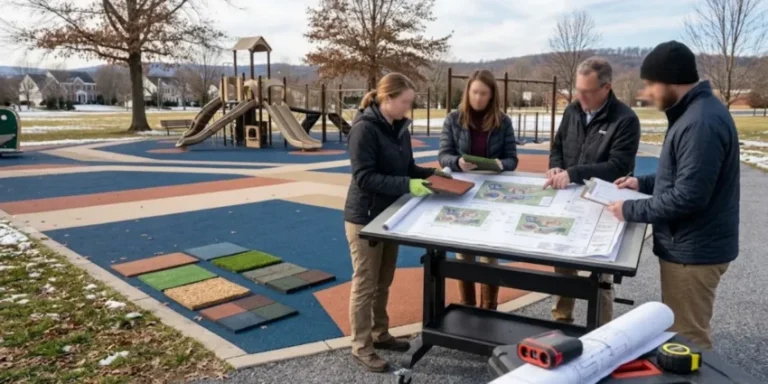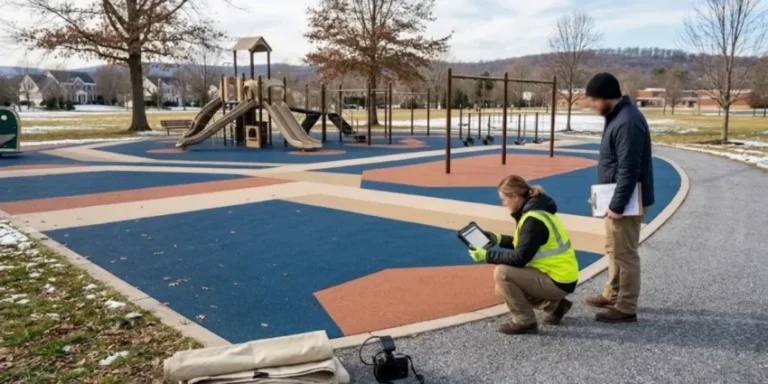
Owners and designers can evaluate playground surfacing accessibility by reviewing the project with qualified accessibility, design, technical, and local-code advisors instead of relying on a product label alone. This article is general planning information for people thinking through a playground project. It links to public resources from the U.S. Access Board, ASTM International, and the Consumer Product Safety Commission to support more informed conversations with designers, contractors, and surfacing providers. For an overview of surface types, see Custom Park Surfacing’s playground surfacing options.
The Access Board publishes technical guidelines for play areas, including ground surfaces that children and caregivers travel across. The Board states plainly that it does not evaluate or certify products for compliance. The notes that follow are a planning reference. They are not legal advice, and they do not substitute for a qualified review of your specific project by an engineer, architect, or accessibility consultant familiar with your site conditions and local code. Every project should be reviewed with qualified advisors before decisions are finalized.
Key Takeaways
- A product sheet is one source of project information; qualified advisors can explain what additional project-specific review is appropriate.
- The Access Board does not certify products. Its guidance describes play-area accessibility considerations, and owners and designers are responsible for working with qualified professionals to apply that guidance to their project.
- ASTM F1292 and ASTM F1951 are frequently referenced in playground-surfacing discussions. Qualified advisors can explain whether and how either applies to a particular project.
- Owners can ask a surfacing provider to discuss how a proposed system relates to the project information available at that stage.
- Owners may want to discuss inspection records and ongoing care information with the project team during planning.
Why do playground surfaces matter for accessibility planning?
The ground surface is the primary path children and caregivers use to reach play equipment, so it often becomes a central topic in accessibility discussions. The Access Board publishes a Chapter 10: Play Areas guide that describes accessibility considerations for play-area surfaces, including concepts such as firmness, stability, and slip resistance along accessible routes. Owners and designers can use this guide as a reference when discussing surface choices with their project team and accessibility consultant.
The same Access Board guide also addresses what happens when ground surfaces are replaced. Owners planning a surface replacement project should ask their design professional and local code official which accessibility provisions apply to the scope of work they are undertaking. The answer often depends on the extent of the work and the specific requirements adopted by the local jurisdiction.
What does the Access Board guide describe about playground surfaces?
The Access Board guide describes surface characteristics that support accessibility, including firmness, stability, and slip resistance along accessible routes. It references ASTM F1951 as one method for evaluating whether a surface material permits wheelchair travel. The guide also addresses impact attenuation in equipment use zones, noting that ASTM F1292 provides a specification for measuring how a surface absorbs impact. These are two distinct performance areas: one relates to getting to the play equipment, the other to what happens around it. Owners and designers should discuss both with a qualified professional who can advise on how the relevant standards apply to their specific project.
The Access Board’s guidance also addresses accessible routes and play components. A design professional can use the guide as a reference while assessing the particular site and project scope.
How do product claims differ from project outcomes?
A product claim describes information supplied by a manufacturer. A project review addresses the proposed installation in its own setting. The Access Board states that it does not evaluate or certify products and advises users to obtain and review product specifications. That distinction gives owners a reason to discuss both product information and project-specific questions with qualified advisors.
Owners may want to treat the product specification as a starting point for further discussion rather than a project conclusion. Questions to explore with a design team can include how the proposed system relates to available equipment information, site conditions, drainage observations, and transitions to adjacent areas. A design professional or qualified installer can explain which of those questions are relevant to the proposed work.
What reference documents and standards are commonly discussed?
Three reference documents often appear in playground-surfacing conversations. Each addresses a different topic and can be reviewed with qualified advisors during project planning.
ASTM F1292 is titled “Standard Specification for Impact Attenuation of Surfacing Materials Within the Use Zone of Playground Equipment.” The current listing, ASTM F1292-22, gives owners a reference to discuss with the project team when impact attenuation is part of the project conversation.
ASTM F1951 is referenced by the Access Board guide in its discussion of accessible surface characteristics. A design professional can advise on whether and how that reference is relevant to a given project and what documentation, if any, is appropriate to request.
The CPSC Public Playground Safety Handbook is published by the Consumer Product Safety Commission as a safety resource. Owners can review the handbook with their project team to identify questions relevant to their own site. For related context, see our discussion of Maryland playground surface regulations.
What topics should owners discuss with a surfacing provider before installation?
Early conversations with a surfacing provider can help owners identify project questions. Available site plans and equipment information can give the provider useful context. Topics an owner or designer may want to raise include:
- How does the proposed surface system relate to the specific equipment and fall heights on our site plan?
- What base preparation and drainage approach does the provider typically recommend, and how might soil type or site grade affect the recommendation?
- What information would help the provider understand the project scope?
- How will the accessible route be laid out on the site plan, and can the provider describe which play components it connects?
- How are transitions handled between different surface types or between the playground surface and adjacent hardscape?
- What documentation does the provider typically supply at project turnover, and what maintenance guidance is included?
These questions can help an owner identify the information still needed before making decisions. For project-coordination context, see surfacing installation project management.
What should owners know about post-installation documentation?
As a project approaches completion, owners can ask the project team what records are appropriate to retain. A design professional or project manager can advise on project-specific documentation, inspection questions, and any evaluation that may be relevant to the completed work.
Site plans, product information, inspection notes, photographs, and other project records can be organized according to the owner’s process and the advice of qualified professionals. For an overview of this service area, see playground surface installation.
What questions should a playground surfacing planning checklist address?
| Area of inquiry | Reference document worth discussing | Topic to raise with design team | Phase of project |
|---|---|---|---|
| Surface accessibility characteristics | Access Board Chapter 10 guide | Whether and how ASTM F1951 testing is appropriate for this project | Design and planning phase |
| Impact attenuation in equipment use zones | ASTM F1292 | How proposed surface thickness relates to equipment fall heights on the site plan | Design and planning phase |
| Accessible route layout | Access Board Chapter 10 guide | Whether the route connects the required play components and entry points | Design review and pre-installation walkthrough |
| Surface thickness and coverage | Manufacturer recommendations | Verification at multiple points across the playground, especially high-wear zones | During installation and at turnover |
| Slip resistance and surface stability | Access Board guidance (firm, stable, slip resistant) | Visual inspection and any applicable testing | At turnover and during routine inspections |
| Ongoing condition and maintenance schedule | CPSC Public Playground Safety Handbook | Written maintenance plan with inspection frequency and documentation approach | Before opening and throughout service life |
Frequently Asked Questions
Is there a single surface material that the Access Board guide requires?
The Access Board guide does not identify a specific required surface material. It describes performance characteristics such as firmness, stability, and slip resistance for accessible routes, and it references impact attenuation standards for equipment use zones. Different materials such as poured-in-place rubber, bonded rubber mulch, engineered wood fiber, and artificial turf may be discussed with a design professional, who can advise on which options are appropriate for a given project’s site conditions, budget, and maintenance capacity.
Does a product data sheet take the place of site-specific documentation?
A product data sheet describes what the material achieved under controlled laboratory conditions. It does not account for the specific sub-base, installation thickness, drainage conditions, or climate factors at a particular site. The Access Board advises users to obtain and review product specifications, but it does not certify products. Owners may want to discuss with their design professional what type of site-specific documentation is appropriate for their project and at what stage it should be collected.
What should owners know about loose-fill surface materials?
Loose-fill materials such as engineered wood fiber can shift under load and may require regular attention to maintain a traversable surface. Owners considering loose-fill options may want to ask their design professional about how the material behaves over time, what maintenance schedule is realistic for their facility, and whether unitary surface options offer a different long-term maintenance profile. The decision often depends on available maintenance staff, expected use levels, and budget. A design professional can walk through the trade-offs for a specific project.
What should an owner consider when replacing an existing playground surface?
Surface replacement can trigger accessibility provisions depending on the scope of work and the requirements adopted by the local jurisdiction. Owners planning a surface replacement should ask their design professional and local code official which provisions apply to the planned scope of work. Routine activities such as topping off loose fill may be treated differently from a full surface replacement. Understanding these distinctions early in the planning phase can help avoid surprises during permitting or inspection.
Do accessibility considerations apply differently to different types of playgrounds?
The Access Board guide describes play-area accessibility considerations that are referenced by various federal, state, and local requirements. The specific provisions that apply to a given project depend on factors including who owns the site, how it is funded, and which codes the local jurisdiction has adopted. Owners of public parks, schools, childcare centers, and commercial playgrounds should ask a qualified professional which accessibility requirements apply to their specific project and site. Making assumptions without that review can lead to gaps in planning.
How do owners think about maintaining surface condition over time?
There is no single maintenance schedule that fits every playground. The CPSC Public Playground Safety Handbook offers general guidance on inspection frequency and what to look for. Owners may want to develop a written maintenance plan with their project team that covers visual inspection intervals, documented inspection intervals, and when to consider more formal surface evaluation. Playgrounds with heavy use, extreme weather exposure, or surfaces nearing the end of their expected service life may need more frequent attention. Discussing the maintenance plan before the playground opens helps set expectations for staff and budget.
Who is responsible for making sure a playground surface meets accessibility goals?
Owners typically carry the responsibility for project outcomes, including accessibility. In practice, responsibility is shared across the project team: the design professional specifies the approach, the contractor installs according to the specifications, and the surfacing provider supplies the material and installation expertise. Owners may want to work with their legal counsel and design professional to define each party’s responsibilities in the contract documents so that expectations are clear from the start. No single subcontractor’s assurance replaces the owner’s need to confirm that the finished playground reflects what was specified and intended.
Can a surface serve accessibility needs and impact attenuation needs at the same time?
Accessibility and impact attenuation are two separate performance areas that a playground surface may need to address. A surface that meets accessibility criteria may or may not provide adequate impact attenuation for a given equipment fall height, and the reverse is also true. A qualified design professional can evaluate how the proposed surface system addresses both areas for the specific equipment and site conditions in the project. Some designs use the same material at different thicknesses for accessible routes and use zones, while others use different materials for each purpose, with attention to how the transitions between them are handled.
If you are planning a playground project and want to discuss surfacing decisions with a provider, contact Custom Park Surfacing. A conversation early in the design phase often uncovers questions worth addressing before the project moves into permitting and construction.